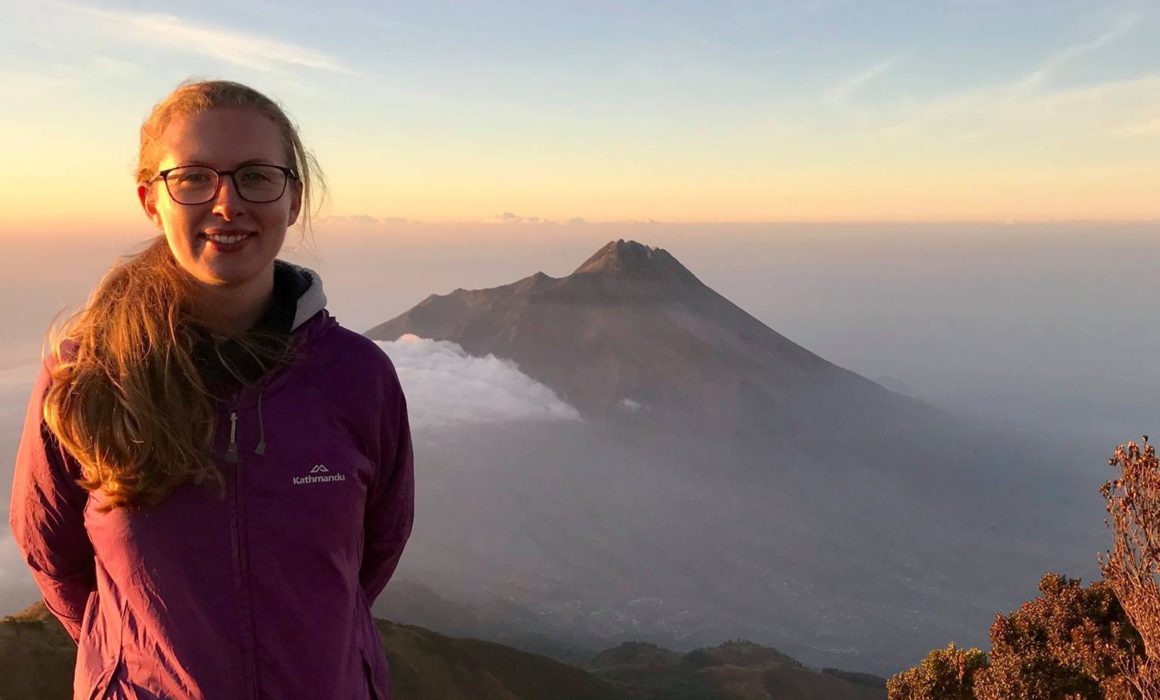
MEMBER SPOTLIGHT — CLARICE CAMPBELL

Welcome back to Member Spotlight learn more about the lives of those behind AIYA. This week, we introduce you to AIYA President, Clarice Campbell!

Welcome back to Member Spotlight learn more about the lives of those behind AIYA. This week, we introduce you to AIYA President, Clarice Campbell!
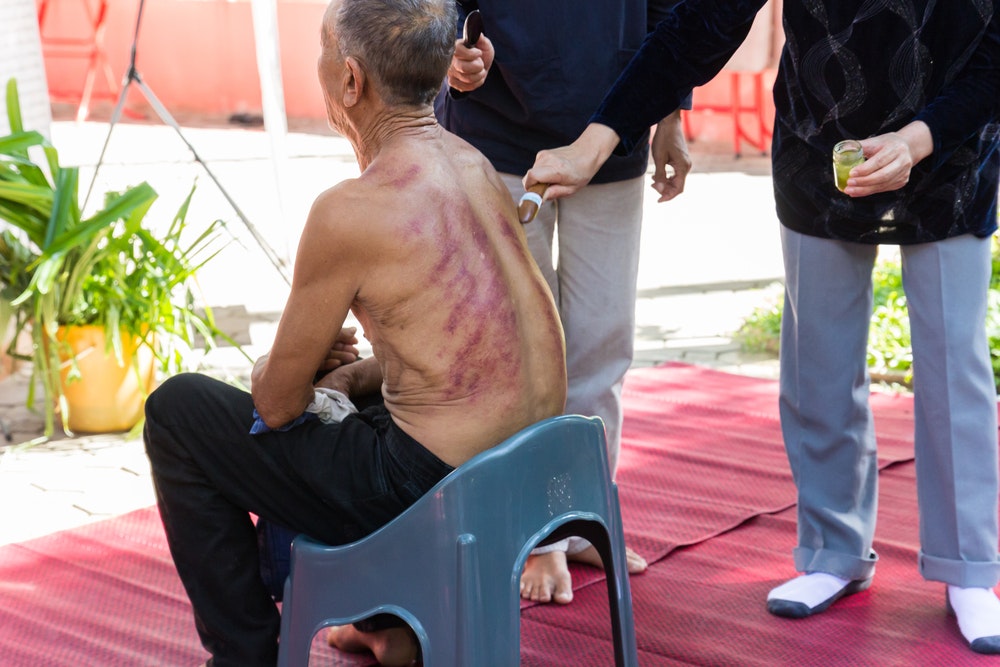
Ketika pelayanan medis menjadi barang komoditas, orang akan beralih ke pengobatan tradisional atau alternatif untuk kesembuhannya. Inilah salah satu alasan mengapa orang melakukan kerokan sebelum memutuskan berobat ke dokter.
By Johanna Debora Imelda, Universitas Indonesia

Lukisan kerokan di becak di Yogyakarta. Kerokan bisa membuat ketagihan psikologis karena ada interaksi antara pengerok dan yang sakit.
Kerokan populer di negara-negara Asia dan tidak banyak dikenal di benua lain. Bahkan praktik ini tidak ikut berasimilasi walaupun banyak orang Asia bermigrasi ke negara lain. Di Vietnam dan Kamboja kerokan dikenal dengan nama cao gio, sementara dalam bahasa Cina disebut gua sha.
Kerokan termasuk terapi yang dermabrasive (merusak kulit) untuk menyembuhkan gejala masuk angin, seperti mual, kehilangan nafsu makan, sakit kepala, dan pusing. Gejala masuk angin ini biasanya timbul saat tubuh terganggu oleh udara dingin yang menyempitkan pembuluh darah dan membatasi asupan oksigen di kulit.
Terkadang, reaksi ini hanya terjadi di beberapa bagian tubuh yang spesifik seperti leher dan bagian belakang tubuh. Kerokan berguna untuk memanaskan tubuh dengan menggosok/mengerok bagian tubuh yang terasa dingin.
Kulit yang digosok akan terbuka dan menghasilkan tanda merah karena pembuluh darah di bawahnya rusak. Namun, reaksi ini memungkinkan kulit untuk menerima lebih banyak oksigen dalam pembuluh darah untuk kemudian menetralkan zat beracun yang ada di dalam tubuh.
Kenyataannya, kerokan bukanlah cara yang efektif meningkatkan panas tubuh dibandingkan dengan misalnya minum air hangat atau ramuan herbal seperti air jahe. Namun, rasa nyaman sehabis kerokan membuat orang ketagihan melakukan kerokan setiap kali merasakan gejala masuk angin.
Umumnya kerokan diaplikasikan di bagian punggung yang dipercaya memiliki 365 titik akupuntur. Apabila dilakukan dengan tekanan yang tepat di titik-titik tersebut, kerokan mempengaruhi sistem syaraf yang akan memerintahkan otak untuk memproduksi hormon endorfin sebagai reaksi tubuh untuk menahan rasa sakit dengan memberikan sensasi relaksasi.
Rasa nyaman ini membuat si penderita bisa tidur nyenyak dan merasa lebih segar setelahnya. Daya tahan tubuh penderita akan meningkat dengan sendirinya setelah tubuh istirahat dengan tidur yang cukup.
Faktanya, gejala masuk angin bisa juga disebabkan karena infeksi virus yang mengganggu sistem pencernaan, pernapasan, dan peredaran darah sehingga timbul demam dan nyeri otot, diikuti dengan bersin dan batuk. Dalam dunia medis, gejala ini dikenal dengan sindrom influenza. Tidak ada satu pun obat yang bisa melenyapkan virus ini.
Virus akan hilang dengan sendirinya dalam 5-7 hari sejalan dengan meningkatnya daya tahan tubuh. Penderita hanya perlu istirahat dengan baik, minum banyak air putih dan makan makanan yang bergizi karena demam menghilangkan banyak energi dan cairan dalam tubuh. Kerokan akan membantu penderita untuk bisa istirahat dengan baik.
Walaupun dianggap tidak berbahaya, kerokan membuat si penderita sangat kesakitan. Kerokan bisa menyebabkan komplikasi dan reaksi alergi pada kulit yang digosok terutama untuk kulit sensitif. Apalagi jika uang koin atau alat lain yang digunakan untuk menggosok kulit tidak disterilkan terlebih dulu. Ini bisa menjadi media penularan penyakit, seperti Hepatitis C.
Nilai dan kepercayaan adalah alasan mengapa orang Indonesia melakukan kerokan. Di masyarakat, respons terhadap penyakit berakar dalam sistem kepercayaan dan praktik yang memiliki struktur logika tersendiri.
Walaupun dari sudut pandang ilmiah, keyakinan akan penyebab suatu penyakit tidak masuk akal, namun pengobatan dan perawatan dari penyakit tersebut merupakan konsekuensi yang logis dari kepercayaan tersebut. Dalam pengobatan tradisional, seperti kerokan, logika pengobatan diyakini bersama antara penderita dan pemberi layanan karena mereka memiliki sudut pandang dan dasar nilai budaya yang sama.
Pengobatan tradisional Indonesia dipengaruhi oleh filosofi Cina sejak abad kelima. Pengobatan Cina meyakini bahwa keseimbangan antara panas (yang) dan dingin (yin) mempengaruhi keharmonisan hubungan antara kondisi spiritual dan fisik dari tubuh dengan alam.
Seseorang akan sakit bila tubuh tidak dalam keadaan yang harmonis dan seimbang. Logika inilah yang diyakini masyarakat Indonesia dalam melakukan kerokan. Kerokan diyakini sebagai praktik untuk mengeluarkan angin dingin penyebab penyakit dengan menggosok kulit di bagian yang terkena angin sampai bagian tersebut terasa panas. Tanda merah di kulit menjadi simbol hilangnya angin dari dalam tubuh.
Keluarnya keringat dan buang angin setelah kerokan juga diyakini menandakan hilangnya angin dingin dalam tubuh manusia. Dalam sudut pandang ilmiah ini irasional dan tidak masuk akal karena tidak mungkin angin bisa keluar masuk tubuh manusia melalui cara tersebut. Tetapi masyarakat mempunyai logika tersendiri dalam menyembuhkan suatu penyakit.
Pengobatan tradisional yang memiliki dampak psikososial dan psikoterapis membuat orang menjadi kecanduan akan kerokan. Kerokan memerlukan bantuan orang lain karena diaplikasikan di bagian belakang tubuh. Walaupun kerokan lebih mujarab bila dilakukan oleh tukang pijat yang berpengalaman, namun semua orang bisa melakukannya.
Seperti kebanyakan pengobatan tradisional lain, kerokan dipelajari secara turun temurun, biasanya oleh anggota keluarga perempuan, terutama ibu yang dianggap bertanggung jawab atas kesehatan keluarga.
Apalagi selama proses kerokan akan terjadi interaksi dan komunikasi yang memungkinkan penderita mengeluarkan uneg-uneg di luar keluhan akan penyakitnya, seperti persoalan keluarga, ekonomi, politik, gosip di tetangga, dan lain sebagainya. Efek psikoterapis inilah yang membuat orang ketagihan melakukan kerokan lagi dan lagi.
Oleh Johanna Debora Imelda, Associate Professor, Universitas Indonesia
Sumber asli artikel ini dari The Conversation. Baca artikel sumber.
This article was originally posted by on The Conversation.
Review: Contemporary Worlds: Indonesia, National Gallery of Australia
They talk of a family of nations, or families of nations. In Australia, the UK can still be referred to as the mother country, while the English talk of their American cousins. Geographic neighbours usually have these relationships down pat, though with a frisson of sibling rivalry or pecking orders of favouritism.
However, one of the truths about Australia and Indonesia, so physically close, is that there is pretty well no familial relationship at all. It’s like we are different species.
I think this is central to the on-again, off-again, try-hard, well-meant, scratchy relationship that struggles to get to first base, always slipping back into the no-man’s-land of “it-is-all-too-hard” and “who-cares-anyway-ville”.
I recently listened to an ABC RN arts program on the Contemporary Worlds: Indonesia exhibition, now at the National Gallery of Australia, where the announcer spoke of Australian artists travelling to “New York or Berlin or London” with no instinctive, familial thought that, just maybe, travelling to “Jakarta, Singapore or Tokyo” might also be part of the mix.

Zico Albaiquni, For evidently, the fine arts do not thrive in the Indies, 2018, oil and synthetic polymer paint on canvas. Courtesy of the artist and Yavuz Gallery, Singapore
Indeed Contemporary Worlds: Indonesia could be from outer space. Despite 30 years of close contact with Indonesia by Australian curators and artists; despite goodwill and a lot of government rhetoric about the “importance of the relationship”; despite so many exchanges and residences and lectures, the nuance is still irredeemably “other”.
I’ve been involved in arts management training programs in Indonesia, curated exhibitions (from 1990, when I organised Eight Views at the National Gallery in Jakarta), been behind the Asialink Artist-in Residency program in Indonesia, served on the Australia-Indonesia Institute (pushing always for strong, intelligent, meaningful arts programs to be supported) and I still see Australians not able to catch Indonesian names, or artists, and hold them as important. Teaching of Indonesian language is struggling; academic inclusion of Indonesian cultural material remains minimal.
Yet Indonesian art was and is great. This exhibition shows many of the reasons why: it is fresh, energetic, human, performative, warm, serious, funny, clever, sensitive, political and not political.
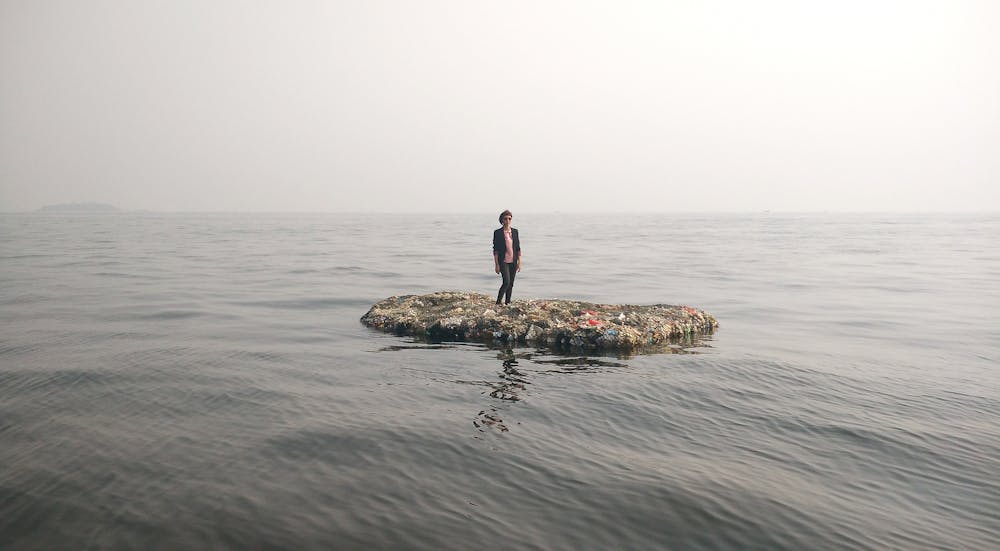
Tita Salina, 1001st Island – the most sustainable island in Archipelago 2015, plastic waste, fishing net, rope, floats, bamboo, LED lights and oil barrels, single-channel video: 14:11 minutes, colour, sound. Courtesy of the artist
There are many wonderful works: Tita Salina has built a raft of rubbish that she rides into Jakarta Bay (shown here as a video), a totally pertinent comment on pollution, but also beautiful and elegaic.
Yudha “Fehung” Kusuma Putera dresses and photographs motley groups of people and animals in cloths that distort their forms – out of it comes humorous but pointed comment on what we are.
Mella Jaasma’s work is classy as usual: a video of a Sufi dancer outlined against the sky, twirling his skirt made of mock Mooi-Indie (“beautiful Indies”) sentimental colonial landscapes. His trance-dance is a comment on humanity’s capacity to seek and find inner strength despite fake news – current and past.Eko Nugroho’s graphic work based on popular culture is relatively well known in Australia, but here he blows three-dimensional air into his usually flat cartoon forms, which then seem about to waddle off down the street.
And then there’s Entang Wiharso’s just wonderful magic house made of cut metal (but it could be of lace cobwebs), lit by a chandelier. It throws shadows to the walls like any self respecting environment for the flat, back-lit forms of wayang puppetry, though on closer inspection the cut forms are illustrations of the artist’s life and world, totally of this day.
This is some of the art of the archipelago. It is an art scene as lively as anywhere and both this and the art is increasingly recognised around the world as being a hot spot of creative energy and interest. Why do Australians not know this?
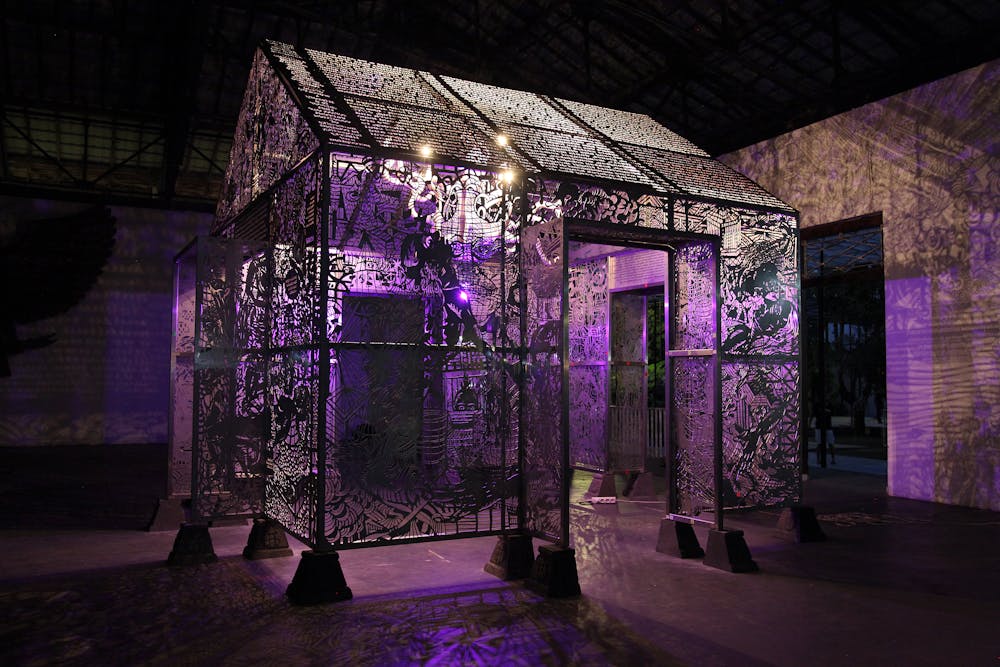
Entang Wiharso, Temple of hope: Door to Nirvana 2018, stainless steel, aluminium, car paint, light bulbs, electric cable and lava stone. National Gallery of Australia, Canberra. Commissioned 2018 and Purchased 2019 © Entang Wiharso, Black Goat Studios
We have had heaps of opportunities, yet this exhibition in Canberra is the first ever of “contemporary” Indonesian art for our premier national visual arts gallery. The NGA has previously held exhibitions of Islamic Indonesian imagery, with calligraphy to the fore, and textiles – both of great quality – but they are not what would be called contemporary art.
Jaklyn Babington, one of the two in-house curators of this new exhibition, was candid about the paucity of Indonesian art in the NGA collection during her talk at the associated conference. This is despite leading curators being nearby at ANU, Caroline Turner in the main, the leader with David Williams and Jim Supangkat in the selection of Indonesian work for the First Asia Pacific Triennial in Brisbane, nearly 30 years ago (with a selection trip in November 1991 in which I also took part). That selection and subsequent ones have seen a significant collection of Indonesian work held in Brisbane … But not Canberra.
The exhibition now in Canberra was obviously put together quickly – too quickly, as Babington noted them not having “long enough” (no criticism here of the curators, caught between changing administrations of the gallery).
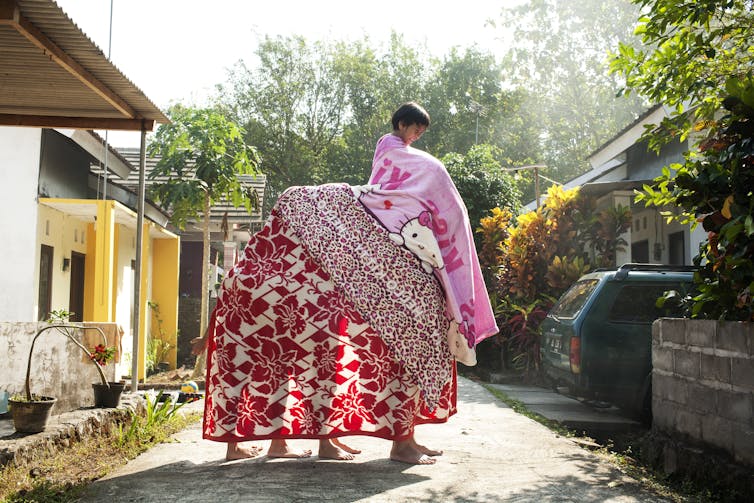
Yudha ‘Fehung’ Kusuma Putera , Past, present and future come together 2017, series of 9 inkjet prints with accompanying instructions for participatory elements of the work. National Gallery of Australia, Canberra. Purchased 2018
Compare the time now put into collecting at the National Gallery Singapore, which recently acquired one of the icons of Indonesian 20th century art, Semsar Siahaan’s Olympia. This is the gallery that had the chutzpah to research and bring together the seminal show of Raden Saleh’s 19th century Indonesian paintings a year ago, and put on their current Awakenings, a serious investigation of 1960-90s art of the region including Indonesia – a show that really offers new research work into this area.
The great themes of Indonesian art need space to emerge: to find the sense of theatre, of the magic lurking in shadows, of the mischief and moral purity of the gods, of the elegance of line and style of a culture trained to see the angle of an arm or the bend of the knee as highly pondered action. The art is also permeated by an easy communal sense of coming together to make cultural objects and performance, including friends and members of villages, both urban and rural, in their creation.
Sunshower, the 2017 exhibition of Southeast Asian Art by major institutions in Tokyo, was given due space and time to work itself into its proper shape. The miraculous program the Japan Foundation instigated in Indonesia ten years ago, Kita! Japanese Artists Meet Indonesia, sent curators and artists to work with Indonesians, in a project that sang with energy and creative interest.
In 2014, there was an inspiring show of Indonesian art at the National Gallery of Victoria in a much smaller space than the NGA has provided, but the two curators Joel Stern and Kristi Monfries, uniting sound with visual art, used their expertise to create something new.
Australia used to be considered a player in Indonesian art scenes. We were proactive; we created collaborative projects; we worked throughout the archipelago – from Timor Barat to Sumatra. In the early 2000s we fell back, just as Indonesians were starting to hit their international stride. Jim Supangkat, doyen curator, said to me around 2005: “where have you Australians gone?”
We went. Partly deterred by events, that is sure, like the Bali bombing, but also by an Australian arts fraternity probably relieved not to have to face Indonesia any more. The Australia Council’s funding of Indonesian projects sank like a stone in these years; only the Australia-Indonesia Institute keeping a frail flame alight.
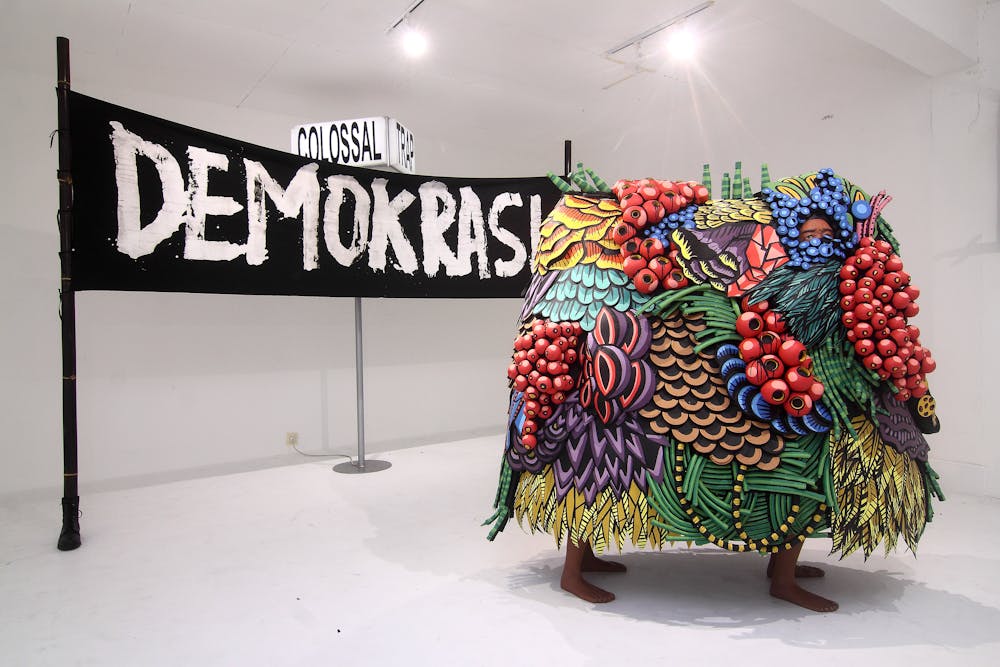
Eko Nugroho , Carnival trap 2 2018, resin, wire, upcycled plastic, iron and syntehtic polymer paint. National Gallery of Australia, Canberra. Purchased 2018
This review started by talking about families, an implication of blood families. If that doesn’t work with Indonesia, what about marriages? Or even engagements? Even dating needs a commitment and, it would be hoped, some sense of a future, some idea that actions now can lead to positive outcomes later.
What about a commitment to trying something for a length of time, say a five-year plan mentality? The big institutions, and the Australia Council, could build programs of yearly collaborations; significant regular talk series; regular curatorial and “interested-others” tours of Java in particular, seeing the arts sights, visiting studios, attending the many performances that abound.
Or what about a commitment to a new Australian Cultural Centre in Yogyakarta? That was mooted some 15 years ago, and a budget put forward, but it languished with the bombing threats. Almost every other country that deals with Indonesia culturally has one of these, except us. It was to be a site for engagement, a site for linkages, for some discussions and exhibitions; not expensive; not staffed by public servants; a bit free and loose like so much in Java that makes the art scene there so beguiling.
This is about a commitment over tokenism; about the long-term; about building knowledge and about keeping delivering. If we aspire in this way, then maybe those personal links will lead to outcomes we all acknowledge as part of our inheritance.

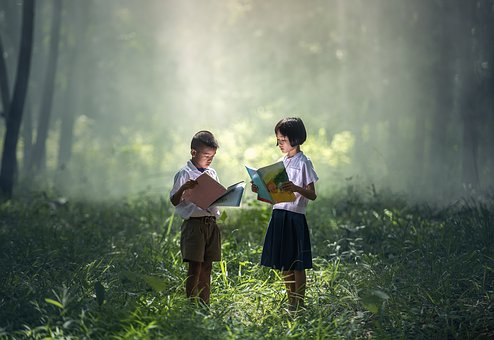

It was Wittgenstein who said “the limits of my language mean the limits of my world”, and one can hardly find arguments against this statement. In the world that is becoming more and more connected and reliant on different cultures, those who have a good command of several languages will find it much easier to find their place under the sun.
In the context of Australia, we should definitely look into the opportunities provided by speaking Indonesian, since Bahasa Indonesia is the second language in this country. So, whether you’d like your kid to use this language for business or some other purpose, it makes perfect sense to help them master the language of a country that is so close and that has so many connections with the Land Down Under. So, what is it that parents can do to help their kids?

Welcome to Catatan AIYA! AIYA Membership numbers continue to grow and our Chapters and other activities are becoming increasingly active. We have been searching for a way to provide further updates to our loyal, paid members. So here it is – the inaugural Catatan AIYA, meaning AIYA Notes. This will likely be a quarterly comprehensive, internal newsletter to keep you posted on everything going on in the world of AIYA.
AIYA National officially has a new President! After four years in the role, Nicholas Mark is passing the AIYA baton over to Clarice Campbell, someone who we’re sure many of you have come to know over the years.
Nick started out as the co-founder and inaugural President of AIYA NSW back in late 2012, and has been AIYA National President since April 2015. He has seen AIYA grow and develop over the years, into a bilateral organisation run by over 150 volunteers and facilitating 300 events a year across both countries. Read more about Nick’s AIYA journey here.

Clarice Campbell has experience in AIYA since 2014, moving through from AIYA VIC President to Operations Officer (Indonesia) and more recently has been the Director of Operations for the past 2 years. Clarice is living and breathing the AIYA vision and mission, and will be the organisation’s first President to be based in Jakarta. AIYA’s greatest strength is as a network that engages young Australians and Indonesians as university students through to their time as young professionals, and Clarice is all set to move AIYA into its next phase.

You will have seen our various comms over the past month about the AIYA Survey 2019. This survey is crucial to inform AIYA about what matters to our members and what we can do to continue to improve. We really appreciate any time you have to complete the survey and we encourage you to share the link through your networks.

With a new AIYA National President, several other roles at AIYA National are also open at the moment as we restructure a fresh National Executive. The following positions are now open for applications until 24 July 2019:
Have you always wanted to join AIYA National or find out more about what AIYA National does? Apply now or contact Clarice at [email protected] to find out more.
As an AIYA Member, you are also eligible to apply for and run in an AIYA Chapter election. Various Chapters will be having their AGM in the coming months. If you are thinking of joining your local AIYA Chapter, we encourage you to contact the current the current executive to find out more and to keep the following months in mind:
More information will be released via the AIYA Links in due course.

AIYA’s flagship initiative is the National Australia-Indonesia Language Awards (NAILA). The 2019 NAILA committee is led by Melanie Kilby and Sheila Hie, and again strives to reward and foster Bahasa Indonesia capabilities in Australia.
Before we open up applications and release the fine print, we want to hear from our members to vote on this year’s theme! Complete this Google Form to have your say.
AIYA is also gearing up to release some mantap AIYA merchandise to celebrate the AIYA Community. AIYA members will soon have an opportunity to contribute to designs and have your say on our 2019/20 merchandise – watch this space!
Got a question about AIYA, Chapters, Catatan AIYA or anything else related to Australia-Indonesia youth? Send us an email to [email protected] and we’ll assist as soon as possible or point you in the right direction!
Salam semangat,

Nick, Clarice & AIYA National

REUTERS / Willy Kurniawan
It has been a long and restless Indonesia democracy fight to say the least, hundreds of election staff (KPU) have died followed by nine demonstrators killed during the riot of civil unrest in the capital city Jakarta last month. With the endless circulation of speculations and hoax used as weapons, this has alarmed the country since the presidential debates rolled out early 2019. Undivided attention given to both of the presidential candidates has pushed numerous crucial problems aside while political conversation had been inevitable for many Indonesians.
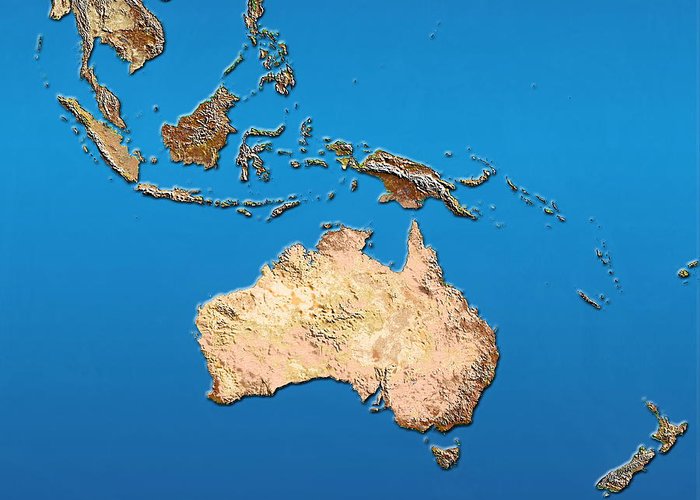

Nowadays many parents send their children to language schools at a very early age. This is something that has been trending for quite some time now and it’s something that’s growing progressively popular. The reason for this can be found in all the benefits of being bilingual, some of which are improved academic success, better communication skills and higher chances of getting a better job somewhere down the road. People choose different languages for their children, usually depending on their location, countries which do most business with their homeland, but also personal preferences. When it comes to Australian children, their parents are showing increased interest in Indonesian and want their children to be able to learn it at school. But, why is Indonesian so important to them? Here are some answers to this question.Read More

The Australia-Indonesia Youth Exchange Program (AIYEP) menghubungkan pemuda di Australia dan Indonesia melalui pertukaran sosial, profesional dan budaya dan berlangsung dari Oktober hingga Februari setiap tahun.
Minggu ini, kita bertemu Rivana Amelia!


Dear AIYA Members, Supporters & Followers,
The Australia-Indonesia Youth Association (AIYA) periodically conducts a survey of its members to identify who you are, where your interests lie and how you would like to see the Australia-Indonesia relationship evolve. AIYA is committed to connecting, informing and inspiring Australian and Indonesian young people, and the ideas and interests of our members are our top priority.
The survey will take around 10 minutes to complete and is completely anonymous. Some optional questions leave room for additional comments, such as on policy issues. We appreciate the extra time you take to complete these questions and express your thoughts on the the things that matter to you.
The survey will be available until Monday, 7 July 2019.
If you have existing networks, friend, family or colleagues who are interested in the Australia-Indonesia relationship (or perhaps have very little interest or existing knowledge!) please share the link to the survey with them. Every submission counts!
For a refresher about our previous 2016 AIYA Survey, please review the full report here.
Thank you very much in advance for all those who are able to complete the survey. We very much look forward to sharing the results with you over the coming months and to implementing some of the feedback into AIYA’s future activities and initiatives.
Salam semangat,Nicholas Mark & AIYA National
 Apalagi selama proses kerokan akan terjadi interaksi dan komunikasi yang memungkinkan penderita mengeluarkan uneg-uneg di luar keluhan akan penyakitnya, seperti persoalan keluarga, ekonomi, politik, gosip di tetangga, dan lain sebagainya. Efek psikoterapis inilah yang membuat orang ketagihan melakukan kerokan lagi dan lagi.