[Member Spotlight] Owen Wishart

Welcome back to Member Spotlight where we introduce you to the personalities behind AIYA. This week, we introduce you to AIYA Yogyakarta Sports officer, Owen Wishart!

Welcome back to Member Spotlight where we introduce you to the personalities behind AIYA. This week, we introduce you to AIYA Yogyakarta Sports officer, Owen Wishart!
 Success often depends on who you know.
Thursday the 8th of August saw AIYA QLD host its second event, and it was a huge success. Malam Karier sets the stage for an excellent and informative evening of discussion on the advantages of smart networking and how to be interview ready. Featuring two very special guests, John Kimlin and Alister Alibi, who shared their expertise in navigating competitive job markets.

The biggest annual Indonesian concert that has been in Melbourne for 13 years, SOUNDSEKERTA, is back on 28 September in Melbourne Town Hall! The theme this year, “Mosaic of Nation”, showcases the power of music by bringing different cultural, ethnic, religious, and linguistic pieces of Indonesia together into a beautiful mosaic. This event provides a sense of nostalgia to Indonesians that are missing home while giving a unique experience for Melbournians to experience Indonesian music. This year, SOUNDSEKERTA has three artists, not two like previous concerts! The three amazing artists are Tompi, RAN, and Yura Yunita.Read More

Welcome back to Member Spotlight learn more about the lives of those behind AIYA. This week, we introduce you to AIYA President, Clarice Campbell!
By Johanna Debora Imelda, Universitas Indonesia
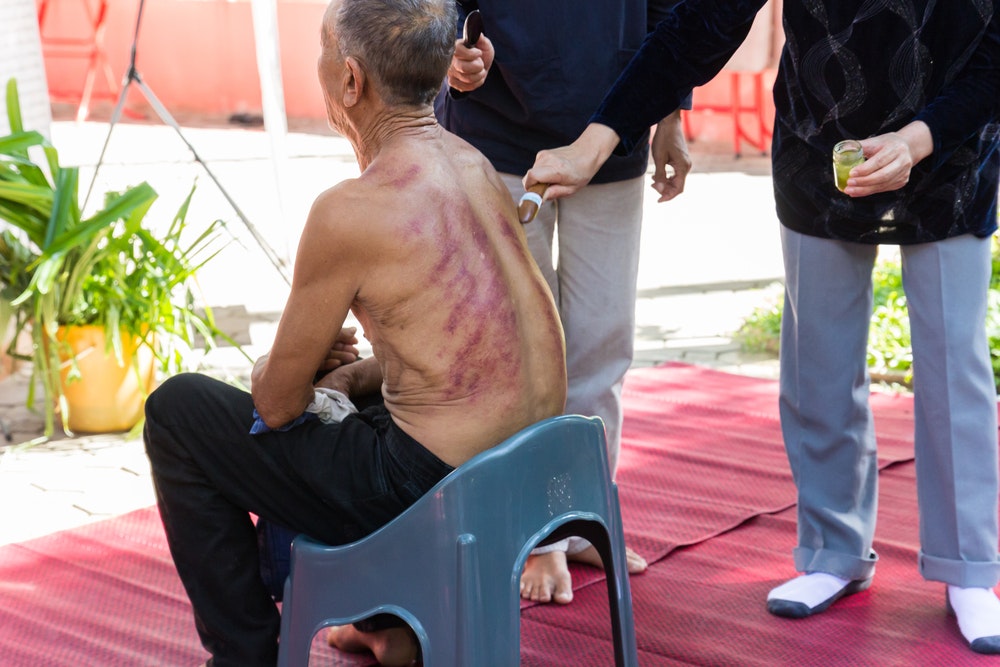
Coin rubbing is a form of folk medication practised in Indonesia and other Southeast Asian and East Asian countries, such as Laos, Thailand, Cambodia, Vietnam, South Korea and southern China. In Vietnam and Cambodia, the practice is called cao gio and in China gua sha. In Indonesia, this practice is known as kerokan, which comes from the Javanese word meaning to scrape.
Kerokan is a dermabrasive therapy used to treat symptoms of the common cold such as nausea, loss of appetite, headache, dizziness and fainting. These can be caused by viral infection, which usually will go away by its own in five to seven days. The sick person only needs a good rest, to drink a lot of water and to eat proper food.
Coin rubbing is one way to warm the body as rubbing the skin produces heat. Kerokan, mostly applied on the back, neck, shoulder and chest, begins and ends with a massage using ointment containing camphor, such as Tiger Balm, Vicks or coconut oil.
Rubbing begins by firmly using the edge of a coin to produce parallel stripes on the chest and the back. It can also be done using other blunt tools, such as spoons, bones or wooden sticks, and for children, shallot with coconut oil.
Some people also take medicine such as paracetamol and aspirin after applying kerokan. The sick person will feel relieved and sleepy, then will get better and feel refreshed after several hours of sleep. The illness will be cured within two or three days after the sick person takes total rest at home.

Indonesian folk medicine is influenced by a Chinese philosophy of health and illness. Chinese traditional medicine has influenced Southeast Asia since the fifth century.
According to Chinese beliefs, health is a state of spiritual and physical harmony with nature. A healthy body is in a state of balance between yinand yang, which are generally translated as hot (yang) and cold (yin), but these refer to qualities, not temperatures.
In some societies, responses to illness are grounded in a system of beliefs and practices, which have their own logical structure. From a scientific standpoint, beliefs about the source of illness might be irrational, but the treatments are a logical consequence of those beliefs.
In the case of kerokan, Indonesian people believe the practice is done to release excess cold wind which is considered responsible for the illness. In Indonesia the symptoms of the common cold are referred to as masuk angin, which literally translates as “the entrance of wind”.
It is said that the reddish mark symbolises the disappearance of the cold wind from the body. It is not entirely true, as a healthy person will get the same reddish mark if his/her skin is being rubbed. People also believe that if the sick person sweats a lot and lets out a fart, this is a sign of the cold wind leaving the body.
If the skin has recovered from the reddish marks, it is said that the wind has been dispersed. It may take two to three days for the skin to be recovered.
Scientifically, the idea sounds irrational because wind cannot enter or leave the body through the skin. It is also not wind inside the body that is responsible for the illness. However, many people believe in this practice and testify to the efficacy.
Some people consider it a harmless procedure, but kerokan causes skin irritation, creating severe red marks that some people say do not fit into modern life. It looks awful if someone goes to the office with kerokanmarks on his/her neck. Nevertheless, people still do kerokan and seem unembarrassed about the reddish marks.
Other side effects include physical and psychological dependence on kerokan; some people routinely do kerokan even though they do not experience serious symptoms.
The body has at least 360 acupuncture points relating to organs inside the body. If kerokan is done properly, the acupuncture points can be reached. Moreover, the rubbing will apply pressure to points that might also affect the nervous system and brain, producing endorphin hormones.
The body produces endorphins as a local reaction to ease pain during the rubbing, but as the rubbing is continuously applied, the body might overproduce the hormone. Endorphin release makes the body deal with pain better, but it can also make the person feel they need it more than necessary.
Others are more dependent on the psychological effect of kerokan. In their book on traditional treatment, George M. Foster and Barbara G. Anderson wrote that it has a psycho-social support and psychotherapy effect. As it is mainly applied on the back part of the body, a proper kerokan should be applied by someone else, preferably an experienced traditional healer, relatives, friends or neighbours.
In The Art of Medical Anthropology, Susan R. Whyte wrote that interaction during treatment can also lead to psychological dependence because one of the characteristics of folk medication is courtesy and friendliness to the clients.
The whole process of kerokan needs at least 30 minutes, when the sick person and the healer can talk about not only the illness, but also family problems, economy, politics and gossip about neighbours.
Besides skill in massaging people, the masseur should have communication skills and experience. They usually know all the neighbourhood gossip and keep up to date with economic and political issues. A masseur without such skills and experience will likely not be hired a second time.
In this sense, the communication during the process of kerokan has psychological benefits for the sick person and it might make one go for kerokan again and again.
By Johanna Debora Imelda, Universitas Indonesia
This article was originally published on The Conversation. Read the original article.
This article was originally posted by on The Conversation.
Review: Contemporary Worlds: Indonesia, National Gallery of Australia
They talk of a family of nations, or families of nations. In Australia, the UK can still be referred to as the mother country, while the English talk of their American cousins. Geographic neighbours usually have these relationships down pat, though with a frisson of sibling rivalry or pecking orders of favouritism.
However, one of the truths about Australia and Indonesia, so physically close, is that there is pretty well no familial relationship at all. It’s like we are different species.
I think this is central to the on-again, off-again, try-hard, well-meant, scratchy relationship that struggles to get to first base, always slipping back into the no-man’s-land of “it-is-all-too-hard” and “who-cares-anyway-ville”.
I recently listened to an ABC RN arts program on the Contemporary Worlds: Indonesia exhibition, now at the National Gallery of Australia, where the announcer spoke of Australian artists travelling to “New York or Berlin or London” with no instinctive, familial thought that, just maybe, travelling to “Jakarta, Singapore or Tokyo” might also be part of the mix.

Zico Albaiquni, For evidently, the fine arts do not thrive in the Indies, 2018, oil and synthetic polymer paint on canvas. Courtesy of the artist and Yavuz Gallery, Singapore
Indeed Contemporary Worlds: Indonesia could be from outer space. Despite 30 years of close contact with Indonesia by Australian curators and artists; despite goodwill and a lot of government rhetoric about the “importance of the relationship”; despite so many exchanges and residences and lectures, the nuance is still irredeemably “other”.
I’ve been involved in arts management training programs in Indonesia, curated exhibitions (from 1990, when I organised Eight Views at the National Gallery in Jakarta), been behind the Asialink Artist-in Residency program in Indonesia, served on the Australia-Indonesia Institute (pushing always for strong, intelligent, meaningful arts programs to be supported) and I still see Australians not able to catch Indonesian names, or artists, and hold them as important. Teaching of Indonesian language is struggling; academic inclusion of Indonesian cultural material remains minimal.
Yet Indonesian art was and is great. This exhibition shows many of the reasons why: it is fresh, energetic, human, performative, warm, serious, funny, clever, sensitive, political and not political.
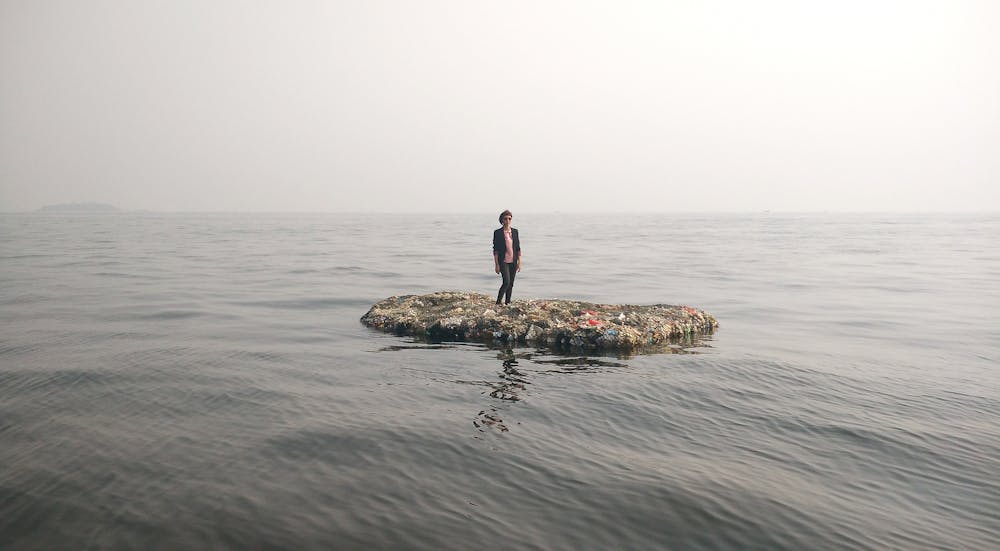
Tita Salina, 1001st Island – the most sustainable island in Archipelago 2015, plastic waste, fishing net, rope, floats, bamboo, LED lights and oil barrels, single-channel video: 14:11 minutes, colour, sound. Courtesy of the artist
There are many wonderful works: Tita Salina has built a raft of rubbish that she rides into Jakarta Bay (shown here as a video), a totally pertinent comment on pollution, but also beautiful and elegaic.
Yudha “Fehung” Kusuma Putera dresses and photographs motley groups of people and animals in cloths that distort their forms – out of it comes humorous but pointed comment on what we are.
Mella Jaasma’s work is classy as usual: a video of a Sufi dancer outlined against the sky, twirling his skirt made of mock Mooi-Indie (“beautiful Indies”) sentimental colonial landscapes. His trance-dance is a comment on humanity’s capacity to seek and find inner strength despite fake news – current and past.Eko Nugroho’s graphic work based on popular culture is relatively well known in Australia, but here he blows three-dimensional air into his usually flat cartoon forms, which then seem about to waddle off down the street.
And then there’s Entang Wiharso’s just wonderful magic house made of cut metal (but it could be of lace cobwebs), lit by a chandelier. It throws shadows to the walls like any self respecting environment for the flat, back-lit forms of wayang puppetry, though on closer inspection the cut forms are illustrations of the artist’s life and world, totally of this day.
This is some of the art of the archipelago. It is an art scene as lively as anywhere and both this and the art is increasingly recognised around the world as being a hot spot of creative energy and interest. Why do Australians not know this?
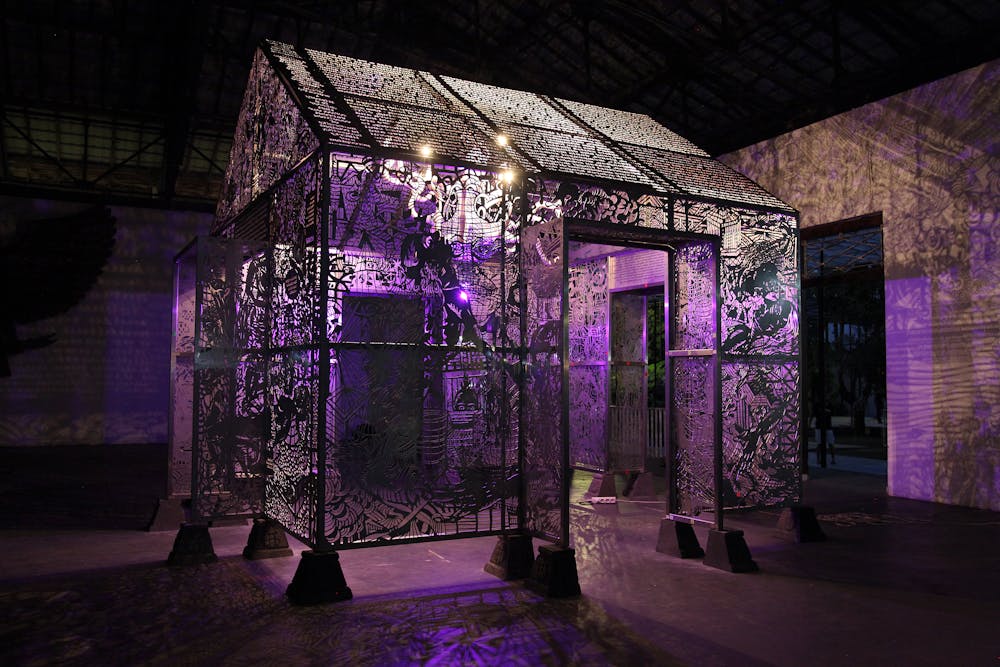
Entang Wiharso, Temple of hope: Door to Nirvana 2018, stainless steel, aluminium, car paint, light bulbs, electric cable and lava stone. National Gallery of Australia, Canberra. Commissioned 2018 and Purchased 2019 © Entang Wiharso, Black Goat Studios
We have had heaps of opportunities, yet this exhibition in Canberra is the first ever of “contemporary” Indonesian art for our premier national visual arts gallery. The NGA has previously held exhibitions of Islamic Indonesian imagery, with calligraphy to the fore, and textiles – both of great quality – but they are not what would be called contemporary art.
Jaklyn Babington, one of the two in-house curators of this new exhibition, was candid about the paucity of Indonesian art in the NGA collection during her talk at the associated conference. This is despite leading curators being nearby at ANU, Caroline Turner in the main, the leader with David Williams and Jim Supangkat in the selection of Indonesian work for the First Asia Pacific Triennial in Brisbane, nearly 30 years ago (with a selection trip in November 1991 in which I also took part). That selection and subsequent ones have seen a significant collection of Indonesian work held in Brisbane … But not Canberra.
The exhibition now in Canberra was obviously put together quickly – too quickly, as Babington noted them not having “long enough” (no criticism here of the curators, caught between changing administrations of the gallery).
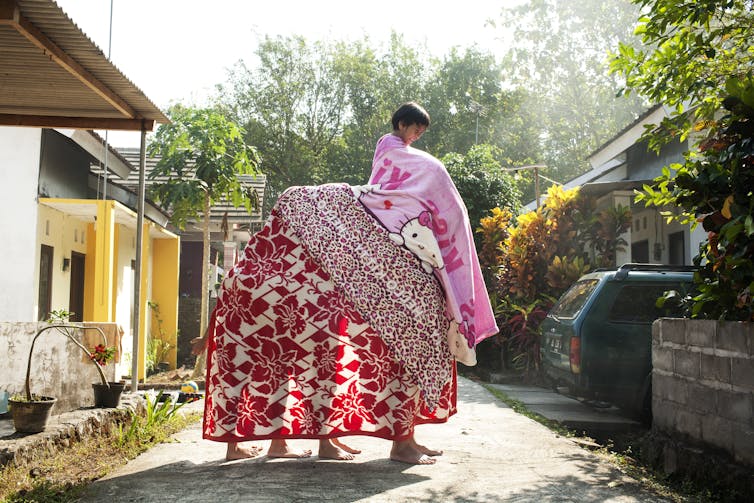
Yudha ‘Fehung’ Kusuma Putera , Past, present and future come together 2017, series of 9 inkjet prints with accompanying instructions for participatory elements of the work. National Gallery of Australia, Canberra. Purchased 2018
Compare the time now put into collecting at the National Gallery Singapore, which recently acquired one of the icons of Indonesian 20th century art, Semsar Siahaan’s Olympia. This is the gallery that had the chutzpah to research and bring together the seminal show of Raden Saleh’s 19th century Indonesian paintings a year ago, and put on their current Awakenings, a serious investigation of 1960-90s art of the region including Indonesia – a show that really offers new research work into this area.
The great themes of Indonesian art need space to emerge: to find the sense of theatre, of the magic lurking in shadows, of the mischief and moral purity of the gods, of the elegance of line and style of a culture trained to see the angle of an arm or the bend of the knee as highly pondered action. The art is also permeated by an easy communal sense of coming together to make cultural objects and performance, including friends and members of villages, both urban and rural, in their creation.
Sunshower, the 2017 exhibition of Southeast Asian Art by major institutions in Tokyo, was given due space and time to work itself into its proper shape. The miraculous program the Japan Foundation instigated in Indonesia ten years ago, Kita! Japanese Artists Meet Indonesia, sent curators and artists to work with Indonesians, in a project that sang with energy and creative interest.
In 2014, there was an inspiring show of Indonesian art at the National Gallery of Victoria in a much smaller space than the NGA has provided, but the two curators Joel Stern and Kristi Monfries, uniting sound with visual art, used their expertise to create something new.
Australia used to be considered a player in Indonesian art scenes. We were proactive; we created collaborative projects; we worked throughout the archipelago – from Timor Barat to Sumatra. In the early 2000s we fell back, just as Indonesians were starting to hit their international stride. Jim Supangkat, doyen curator, said to me around 2005: “where have you Australians gone?”
We went. Partly deterred by events, that is sure, like the Bali bombing, but also by an Australian arts fraternity probably relieved not to have to face Indonesia any more. The Australia Council’s funding of Indonesian projects sank like a stone in these years; only the Australia-Indonesia Institute keeping a frail flame alight.
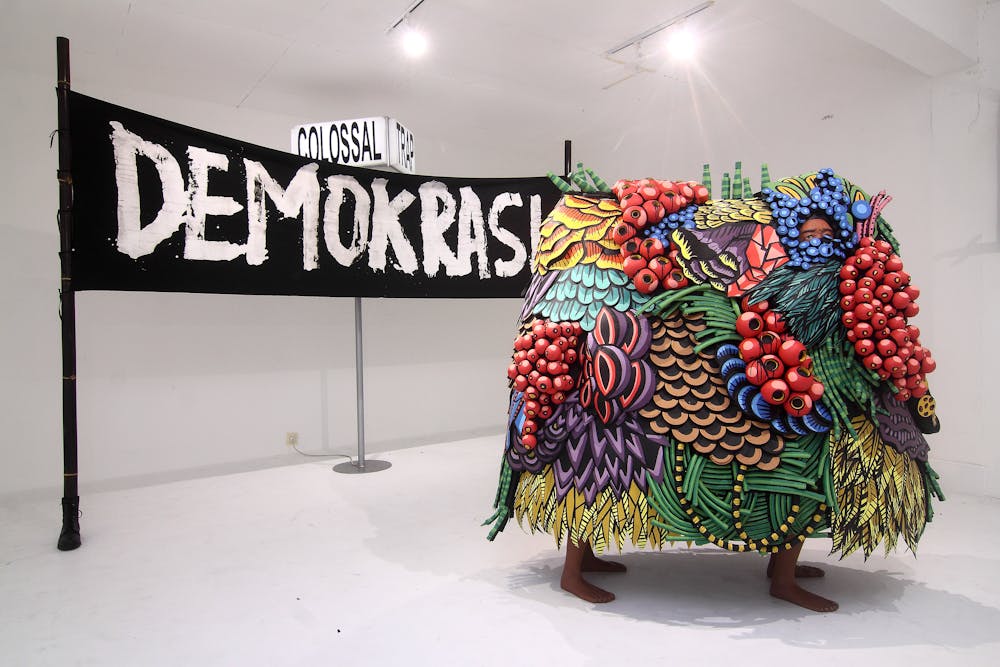
Eko Nugroho , Carnival trap 2 2018, resin, wire, upcycled plastic, iron and syntehtic polymer paint. National Gallery of Australia, Canberra. Purchased 2018
This review started by talking about families, an implication of blood families. If that doesn’t work with Indonesia, what about marriages? Or even engagements? Even dating needs a commitment and, it would be hoped, some sense of a future, some idea that actions now can lead to positive outcomes later.
What about a commitment to trying something for a length of time, say a five-year plan mentality? The big institutions, and the Australia Council, could build programs of yearly collaborations; significant regular talk series; regular curatorial and “interested-others” tours of Java in particular, seeing the arts sights, visiting studios, attending the many performances that abound.
Or what about a commitment to a new Australian Cultural Centre in Yogyakarta? That was mooted some 15 years ago, and a budget put forward, but it languished with the bombing threats. Almost every other country that deals with Indonesia culturally has one of these, except us. It was to be a site for engagement, a site for linkages, for some discussions and exhibitions; not expensive; not staffed by public servants; a bit free and loose like so much in Java that makes the art scene there so beguiling.
This is about a commitment over tokenism; about the long-term; about building knowledge and about keeping delivering. If we aspire in this way, then maybe those personal links will lead to outcomes we all acknowledge as part of our inheritance.

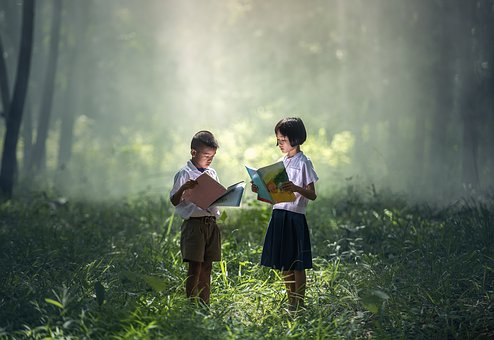

It was Wittgenstein who said “the limits of my language mean the limits of my world”, and one can hardly find arguments against this statement. In the world that is becoming more and more connected and reliant on different cultures, those who have a good command of several languages will find it much easier to find their place under the sun.
In the context of Australia, we should definitely look into the opportunities provided by speaking Indonesian, since Bahasa Indonesia is the second language in this country. So, whether you’d like your kid to use this language for business or some other purpose, it makes perfect sense to help them master the language of a country that is so close and that has so many connections with the Land Down Under. So, what is it that parents can do to help their kids?

Welcome to Catatan AIYA! AIYA Membership numbers continue to grow and our Chapters and other activities are becoming increasingly active. We have been searching for a way to provide further updates to our loyal, paid members. So here it is – the inaugural Catatan AIYA, meaning AIYA Notes. This will likely be a quarterly comprehensive, internal newsletter to keep you posted on everything going on in the world of AIYA.
AIYA National officially has a new President! After four years in the role, Nicholas Mark is passing the AIYA baton over to Clarice Campbell, someone who we’re sure many of you have come to know over the years.
Nick started out as the co-founder and inaugural President of AIYA NSW back in late 2012, and has been AIYA National President since April 2015. He has seen AIYA grow and develop over the years, into a bilateral organisation run by over 150 volunteers and facilitating 300 events a year across both countries. Read more about Nick’s AIYA journey here.

Clarice Campbell has experience in AIYA since 2014, moving through from AIYA VIC President to Operations Officer (Indonesia) and more recently has been the Director of Operations for the past 2 years. Clarice is living and breathing the AIYA vision and mission, and will be the organisation’s first President to be based in Jakarta. AIYA’s greatest strength is as a network that engages young Australians and Indonesians as university students through to their time as young professionals, and Clarice is all set to move AIYA into its next phase.

You will have seen our various comms over the past month about the AIYA Survey 2019. This survey is crucial to inform AIYA about what matters to our members and what we can do to continue to improve. We really appreciate any time you have to complete the survey and we encourage you to share the link through your networks.

With a new AIYA National President, several other roles at AIYA National are also open at the moment as we restructure a fresh National Executive. The following positions are now open for applications until 24 July 2019:
Have you always wanted to join AIYA National or find out more about what AIYA National does? Apply now or contact Clarice at [email protected] to find out more.
As an AIYA Member, you are also eligible to apply for and run in an AIYA Chapter election. Various Chapters will be having their AGM in the coming months. If you are thinking of joining your local AIYA Chapter, we encourage you to contact the current the current executive to find out more and to keep the following months in mind:
More information will be released via the AIYA Links in due course.

AIYA’s flagship initiative is the National Australia-Indonesia Language Awards (NAILA). The 2019 NAILA committee is led by Melanie Kilby and Sheila Hie, and again strives to reward and foster Bahasa Indonesia capabilities in Australia.
Before we open up applications and release the fine print, we want to hear from our members to vote on this year’s theme! Complete this Google Form to have your say.
AIYA is also gearing up to release some mantap AIYA merchandise to celebrate the AIYA Community. AIYA members will soon have an opportunity to contribute to designs and have your say on our 2019/20 merchandise – watch this space!
Got a question about AIYA, Chapters, Catatan AIYA or anything else related to Australia-Indonesia youth? Send us an email to [email protected] and we’ll assist as soon as possible or point you in the right direction!
Salam semangat,

Nick, Clarice & AIYA National

REUTERS / Willy Kurniawan
It has been a long and restless Indonesia democracy fight to say the least, hundreds of election staff (KPU) have died followed by nine demonstrators killed during the riot of civil unrest in the capital city Jakarta last month. With the endless circulation of speculations and hoax used as weapons, this has alarmed the country since the presidential debates rolled out early 2019. Undivided attention given to both of the presidential candidates has pushed numerous crucial problems aside while political conversation had been inevitable for many Indonesians.
